Best Weight Loss Supplement for Women: What the Inositol Evidence Supports
Quick Answer: Is Inositol the Best Weight Loss Supplement for Women?
No supplement earns that title, and inositol is no exception. What the inositol research supports is a modest improvement in metabolic markers such as fasting insulin and insulin sensitivity indexes in specific groups of women, at doses measured in grams per day. Body weight was usually a secondary outcome in those trials, and the weight results are inconsistent.
- Best supported: markers of insulin sensitivity, mainly in women with polycystic ovary syndrome.
- Least supported: body weight itself, which moved little and inconsistently across studies.
- Dose reality: roughly 4 grams a day in most protocols, which no gummy or blend can deliver.

What inositol actually is
Inositol is a small sugar-like molecule. Chemically it is a cyclic sugar alcohol with nine possible arrangements of its hydroxyl groups, of which two matter commercially: myo-inositol, by far the most abundant form in the body, and D-chiro-inositol, a minor form that the body converts myo-inositol into as needed.
It turns up in ordinary food. Beans, whole grains, nuts, citrus and cantaloupe all carry it, mostly bound up as phytate in the case of grains and legumes. Your body also synthesises it from glucose, chiefly in the kidneys. That last fact is the reason it was quietly demoted from its old name, vitamin B8: a vitamin is by definition something you must eat because you cannot make it, and inositol fails that test.
Its job inside cells is signalling. Inositol phosphates and phosphoinositides sit downstream of a number of hormone receptors, including the insulin receptor. That is the mechanistic hook behind the entire body of research discussed here, and it is a real one. The distance between "involved in insulin signalling" and "changes your weight" is where this article lives.
What the trials measured: markers, not the scale
The bulk of the human inositol literature sits in one place: women with polycystic ovary syndrome, a common hormonal and metabolic condition in which insulin resistance is frequently present. Researchers had an obvious reason to look there, and the funding followed.
The outcomes those trials recorded were mostly biochemical. Fasting insulin. Fasting glucose. Calculated insulin sensitivity indexes such as HOMA-IR, which is arithmetic on a fasting blood sample rather than a direct measurement. Androgen levels. Menstrual regularity and ovulation rates. Meta-analyses pooling those trials generally report improvements in the insulin-related markers, with a good deal of variation between studies and a fair amount of methodological unevenness in the underlying trials.
Body weight and body mass index appear in many of those papers, but as secondary outcomes measured over the study window, and the results do not line up neatly. Some trials show a small reduction, some show nothing, and pooled estimates tend to be small enough that they could be produced by the dietary advice everyone in the trial received. That is not a scandal. It is simply what the data says, and it is a different claim from the one you will see on a product page.
A marker moving is a hypothesis about the future. A weight moving is an outcome. The inositol literature is much stronger on the first than on the second, and the gap between them is where most supplement marketing does its work.
The doses used, and the gap to the shelf
This is the detail that decides whether a product is worth anything. The standard protocol across most of the published work is about 4 grams of myo-inositol per day, taken as two 2-gram doses, frequently paired with D-chiro-inositol at a 40 to 1 ratio and with folic acid, because that is how the original formulations were built.
Four grams a day is a heaped teaspoon of powder. It is not something a gummy carries, and it is not something a multi-ingredient appetite blend carries either. When inositol appears in a blend at a token amount, it is there for the label, not for the effect. That single fact disqualifies a great many products that market themselves as the best weight loss supplement for women, and it is checkable in thirty seconds on the Supplement Facts panel.
| Form | Typical amount in published studies | Main outcomes recorded | Strength of evidence |
|---|---|---|---|
| Myo-inositol alone | About 4 g per day, split in two | Fasting insulin, insulin sensitivity index, ovulation | Moderate for markers, weak for weight |
| Myo plus D-chiro-inositol, 40:1 | About 4 g combined per day | Same markers, plus androgen measures | Moderate for markers, weak for weight |
| D-chiro-inositol alone | Hundreds of mg to about 1 g | Insulin markers | Weak, fewer and smaller trials |
| Inositol inside a proprietary blend | Undisclosed, usually tens of mg | Nothing published at that amount | None |
| Dietary inositol from beans, grains, citrus | Roughly a gram a day from a mixed diet | Not isolated in trials | Not applicable |
The bottom two rows are the ones worth staring at. An ingredient studied at grams and sold at milligrams is decoration, and the honest thing to do is say so out loud.

Comparing labels rather than promises
Whatever you end up buying, the test is the same: does the panel disclose milligrams per ingredient, and do those milligrams resemble the research? That question is more useful than any ranking of the best weight loss supplement for women over 40, and it is the reason we publish full panels rather than star ratings.
See the current JellyTide offerWhy women-specific marketing is mostly marketing
There are genuine reasons a supplement might be studied more in women. Inositol is one: the PCOS research base is real, and PCOS affects women. Iron is another, for reasons of menstrual loss. Calcium and vitamin D have sex-specific relevance to bone health after menopause.
But most products aimed at women in the weight-management aisle do not carry those ingredients in meaningful amounts. What they carry is packaging. Pink boxes, a berry flavour and the phrase "formulated for women" are not a formulation difference. If two products have the same panel and one costs more because it is marketed to women, you are paying for the box.
The searches around this topic show the same pattern: best weight loss supplement during menopause, best weight loss supplement for women over 50, and so on. Those are real questions with real physiology behind them, particularly around the loss of lean mass and the shift in fat distribution that accompanies the menopausal transition. The answer to them, though, is mostly protein intake, resistance training and sleep, not a proprietary blend. Supplements are the garnish on that plate.
What inositol cannot do
Plainly, so there is no ambiguity. Inositol is a dietary supplement. It is not a drug, it does not treat, cure or prevent any disease, and nothing here should be read as advice to use it instead of medical care for any condition.
- It cannot be assumed to move body weight. The weight data across the trials is inconsistent, and the studies that reported changes also included dietary instruction.
- It cannot work at gummy doses. The research used grams. This is not a subtle shortfall; it is two orders of magnitude in many products.
- It cannot replace medical management. If insulin resistance or PCOS is on the table, that is a conversation with a clinician who can order the right bloodwork.
- It cannot be judged from marker changes alone. A lower HOMA-IR is encouraging arithmetic, not a demonstrated long-term benefit.
- It is not risk-free at high doses. Gastrointestinal upset, nausea and loose stools are the usual complaints when people push past a few grams a day.
The same caution applies to any ingredient sold on mechanism. We made the identical argument about serotonin precursors in our piece on what the 5-HTP satiety trials actually measured, and the reasoning transfers cleanly.
Where an apple cider vinegar gummy sits in this picture
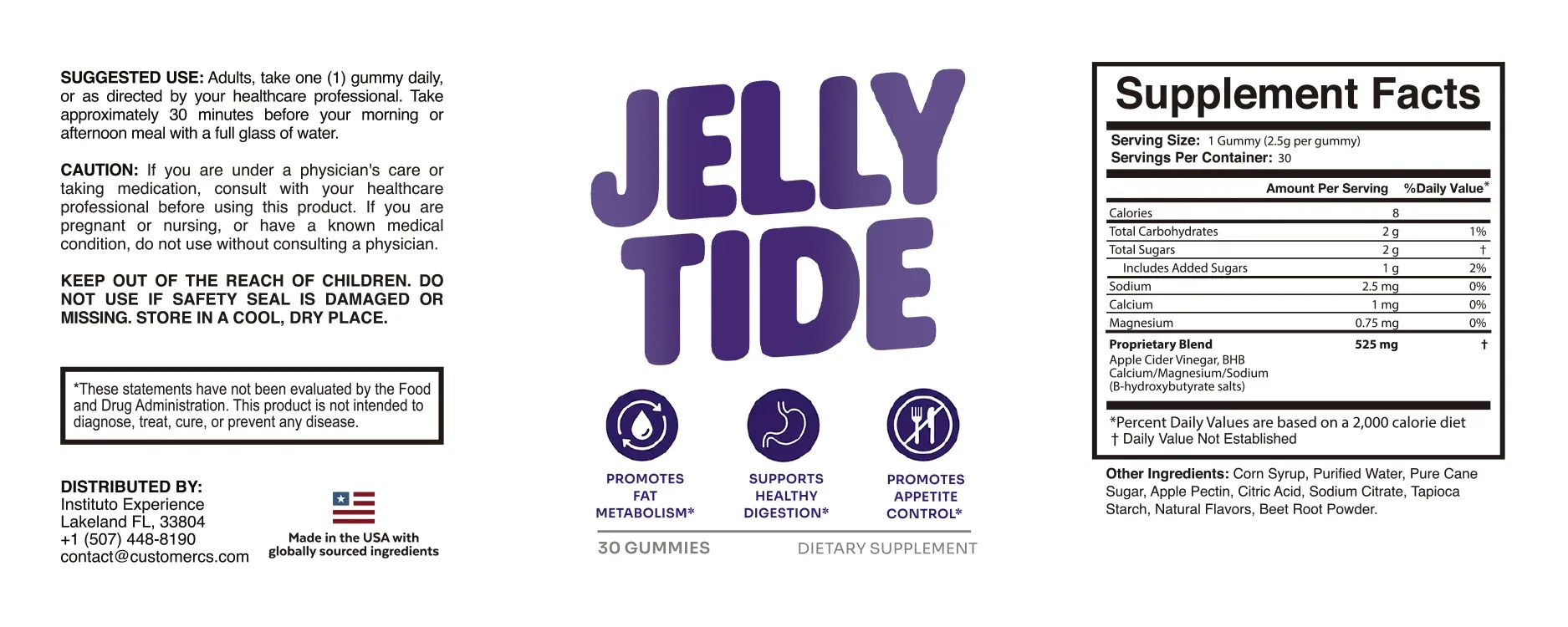
For the avoidance of doubt: JellyTide does not contain inositol. Its 525 mg blend is apple cider vinegar together with beta-hydroxybutyrate calcium, magnesium and sodium. We would rather lose a sale than imply otherwise, because a page that claims an ingredient it does not carry is worthless to you and to us.
What the vinegar side of that panel has behind it is a smaller, more specific claim: small human trials suggest that acetic acid taken with a carbohydrate meal blunts the glucose and insulin response, most likely by slowing gastric emptying. That is a modest finding from small studies, and the trial doses were 15 to 30 millilitres of liquid vinegar, more acetic acid than a gummy delivers. It sits in the same evidence tier as inositol's marker data: directionally interesting, nowhere near decisive.
People searching for where to buy apple cider vinegar gummies are usually not looking for a scientific breakthrough. They are looking for something palatable, cheap and easy to take daily, in a category where the honest ceiling is small. That is a perfectly reasonable thing to want, as long as the expectation matches the evidence.
A practical way to decide
If you want to use the inositol research rather than the marketing built on top of it, the approach is simple. Buy myo-inositol as a plain powder from a manufacturer that discloses grams per scoop, not as one line inside a blend. Take it at the amount the studies used, with food, and give it a fair trial period. Track what the studies tracked, which means bloodwork ordered by a clinician, not the bathroom scale on a Tuesday morning.
And keep the hierarchy straight. Protein at every meal, enough fibre, resistance training twice a week, seven to nine hours of sleep, and a calorie intake you can actually maintain will do more than any ingredient discussed on this page. That is not a fashionable thing to write on a supplement site. It is what the evidence supports, and pretending otherwise would make everything else we publish worth less.
Medical note: this article is general wellness information, not medical advice, and it summarises published evidence rather than making a product claim. JellyTide is a dietary supplement, not a drug, and is not intended to diagnose, treat, cure or prevent any disease. Speak to a healthcare professional before starting any supplement, especially if you are pregnant, nursing or taking medication.
Frequently asked questions
What is inositol and is it a vitamin?
Inositol is a sugar-like compound found in fruits, beans, grains and nuts, and your body also makes it from glucose. It was once called vitamin B8, but that name was dropped because a vitamin is something the body cannot make and inositol does not qualify.
Did inositol trials measure body weight?
Usually as a secondary outcome. The primary outcomes were metabolic markers such as fasting insulin, fasting glucose and insulin sensitivity indexes, plus hormonal and menstrual measures. Weight results across those trials are inconsistent and generally small.
What dose of inositol was used in the research?
The most common protocol was around 4 grams of myo-inositol per day, split into two doses, often combined with D-chiro-inositol in a 40 to 1 ratio and with folic acid. That is grams per day, which is far more than a gummy or a blended appetite product can carry.
Does JellyTide contain inositol?
No. JellyTide is an apple cider vinegar and BHB gummy with a 525 mg blend of apple cider vinegar and beta-hydroxybutyrate calcium, magnesium and sodium. If inositol is what you are after, you would need a dedicated inositol powder, not this product.
Sources
- PubMed — myo-inositol and insulin resistance, randomised trials
- PubMed Central — inositol meta-analyses and pooled outcomes
- NIH Office of Dietary Supplements — dietary supplement fact sheets
- Harvard T.H. Chan School of Public Health — carbohydrates and blood sugar
- Mayo Clinic — polycystic ovary syndrome overview
Check the panel, then the offer
The full JellyTide Supplement Facts panel is transcribed and photographed on the home page, including the arithmetic on how much of the 525 mg blend can be ketone salt. If the label holds up for you, the current offer is one click away.
Check availability and the current offer